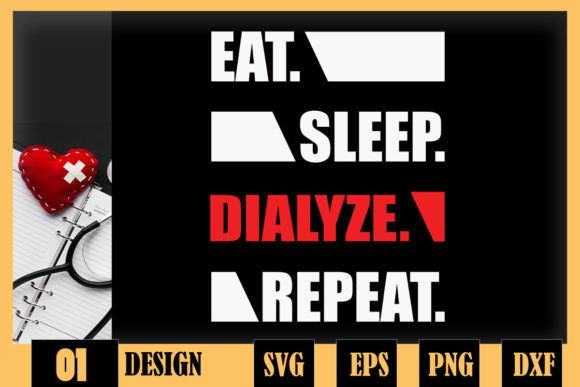
Reviewing Eat Sleep Dialyze Repeat for Nurses
As a designer who spends half my life digitizing and the other half stitching, I have learned that not every machine embroidery design translates well from screen to fabric. Some look crisp on a monitor but turn into a tangled mess of thread breaks and puckering on a sweatshirt. When I first encountered the Eat Sleep Dialyze Repeat Dialysis Nurse graphic, my initial reaction was cautious optimism. The theme is specific, heartfelt, and clearly targeted at a dedicated niche of healthcare professionals. But does it hold up under the needle? I decided to put this embroidery file through its paces to see if it deserves a spot in my commercial portfolio.
First Impressions and Visual Personality
The phrase "Eat Sleep Dialyze Repeat" carries a certain rhythmic weight. It speaks to the relentless schedule of dialysis nurses, blending humor with professional pride. Visually, the layout needs to balance readability with aesthetic appeal. In its digital form, included as part of a versatile bundle containing SVG, PNG, DXF, and EPS files, the design offers flexibility. However, for us embroidery specialists, the vector and raster formats are primarily useful for creating printable mockup previews or cutting vinyl for hybrid projects. The real test is how these shapes translate when we assign stitch types.
The mood of the piece is supportive and resilient. It is not overly clinical; instead, it feels like something a colleague would gift to another after a long shift. This emotional resonance is crucial for handmade product success. If the design feels too rigid or generic, it loses its charm. Fortunately, the typography suggested by the source files allows for clean, bold lettering that can withstand the texture of fabric without becoming illegible.
Real-World Application: The Tote Bag Test
To evaluate practicality, I envisioned this design on a heavy canvas tote bag. This is a staple item for nurses who carry textbooks, scrubs, and personal items. Using a medium-weight stabilizer is non-negotiable here. Canvas has a loose weave, and without proper support, the fill stitch areas of the letters could sink into the fabric, causing distortion.
I mapped out the design assuming a standard 5x7 hoop size. The length of the phrase requires careful centering. If you rush the placement, the word "Repeat" might end up too close to the bottom edge, looking cramped. In my trial run, I opted for a satin stitch border around the text to give it definition against the natural beige of the canvas. The result was striking. The contrast between the thread and the fabric made the message pop, turning a simple utility item into a statement piece. For an Etsy seller, this kind of application adds significant perceived value to a small shop product.
Fabric Considerations and Stitch Density
One must be mindful of where this design is applied. While it works beautifully on sturdy materials like denim aprons or twill caps, it requires adjustment for softer fabrics. If you are planning baby embroidery or delicate knitwear, the original density might be too high. A dense block of text on a thin cotton onesie will cause puckering, no matter how good your stabilizer is. In such cases, I recommend reducing the stitch count by increasing the spacing between lines or switching to a lighter running stitch outline rather than a full fill.
Dark fabrics present another challenge. If you are stitching white thread on navy blue scrubs, ensure your tension is perfect. Any loose threads will show up starkly against the dark background. Conversely, using dark thread on light fabric hides minor imperfections better. Always test your thread colors on scrap fabric before committing to the final finished product. This step saves time, money, and reputation.
Commercial Viability and Brand Consistency
For those running a craft business, consistency is key. The Eat Sleep Dialyze Repeat Dialysis Nurse design fits well within a broader collection of healthcare-themed design assets. It pairs nicely with other medical motifs, such as stethoscopes or heart rate lines, allowing you to create cohesive bundles for commercial embroidery clients. Hospitals and clinics often look for personalized gifts for staff appreciation weeks, and this design hits the mark by acknowledging the specific routine of dialysis care.
However, remember that the downloaded package includes SVG, PNG, DXF, and EPS files. These are primarily Graphics formats used for cutting machines or printing. If you are selling embroidered items, you must ensure you have the actual machine embroidery file formats (such as PES, DST, or JEF) compatible with your specific machine. If the listing does not explicitly state these machine formats are included, you may need to digitize the SVG yourself or contact the seller. Never assume a vector file is ready-to-stitch without proper conversion and testing.
Practical Designer Notes
- Check Licensing: Before selling items made with this design, confirm the license terms. Some creators allow unlimited commercial sales, while others restrict quantity.
- Hoop Size Matters: Measure the total width of the text. Ensure it fits comfortably within your hoop with at least one inch of margin on all sides to prevent hoop burns.
- Stabilizer Selection: Use cut-away stabilizer for stretchy fabrics like jersey knits and tear-away for stable wovens like cotton twill.
- Test Stitch-Outs: Always run a test on similar fabric. Check for thread breaks in tight corners of letters like 'E' and 'R'.
- Contrast Check: View your design in black and white on your computer screen. If the details disappear, the contrast in real life might also be poor.
Final Verdict
The Eat Sleep Dialyze Repeat Dialysis Nurse concept is strong because it speaks directly to the identity of its wearer. As a personalized gift, it shows thoughtfulness. As a custom apparel item, it builds community among healthcare workers. While the provided files are excellent for crafting and digital use, the success of the embroidered version depends entirely on your technical execution. Pay attention to stitch density, choose the right stabilizer, and respect the fabric you are working with. When done correctly, this design elevates a simple garment into a cherished keepsake, proving that thoughtful Crafts and precise technique go hand in hand.